By Bird Parry
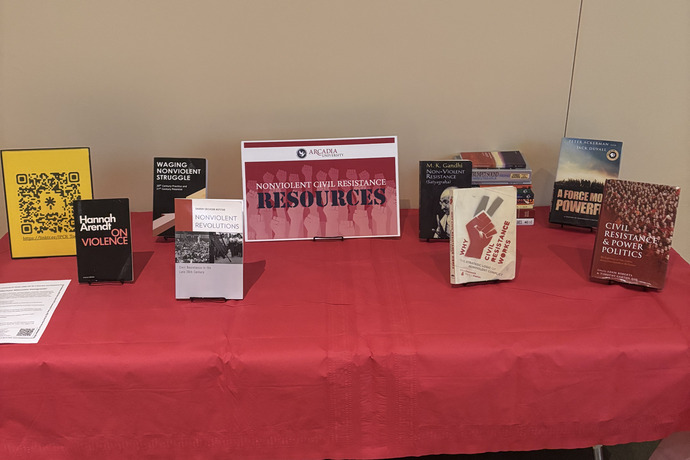
GLENSIDE, Pa (Mar. 13, 2026) – Arcadia University’s International Peace and Conflict Resolution (IPCR) Master of Arts Program collaborated with The Peace Center to teach the Arcadia community the fundamentals to nonviolent civil resistance. “Teach-In: A Toolkit For Nonviolent Civil Resistance” was organized by Arwen Blimes, a graduate student in IPCR, with sections run by Barbara Simmons, the director of The Peace Center, Karen Rodriguez, the co-leader of Bucks County’s chapter of Indivisible Pennsylvania, and Dr. Ariel Otruba, the interim director of Arcadia’s IPCR Program. The event, which was almost exclusively attended by faculty, staff, and graduate students, provided wonderful opportunities and tools to understand the nuances of nonviolent civil resistance.
The event got started with welcome addresses from each of Blimes, Simmons, and Otruba, then session one began. Session one was a non-violence peacekeeper training workshop led by Ms. Simmons. This included plenty of opportunities to speak with unfamiliar people about your ideas and experiences as a peacekeeper.
The highlight of this session, and the afternoon for that matter, was an activity called the “hassle line,” in which participants stood across from each other. One side of the participants had the role of agitating the other side whilst the other side had the role of de-escalating the situation.
After that, there was a brief break for lunch, which was followed by session two: an allies and rapid response training workshop. Then there was a moderated roundtable on immigrant rights activism. Dr. Otruba served as moderator, and the panelists were Josh Blakesley, Hyeonock “Mel” Lee, Denisse Agurto, Stephanie Vincent, and Pennsylvania Senator Art Haywood,
With the controversy surrounding current US immigration policy and the tactics of Immigration Customs Enforcement (ICE), the event served as a source of information to the community. “The presenters were there talking about the ICE demonstrations, and how to navigate an encounter with ICE,” said Allannah Giles, the Assistant Director of Student Operations in Student Governance here at Arcadia.
“I think that these types of events open a space for protected dialogue in spaces that often aren’t discussed because they’re seen as polarizing or uncomfortable,” said Ms. Giles. “The more that people are welcomed in these conversations about resistance, and violence, and things that are more polarizing, the more the power’s brought away from the conversations and actually put into action.”
With that being said, the event did struggle in terms of turnout. A decent amount of faculty and staff attended, as well as some graduate students, but very few undergraduate students, if any attended, the event. “I was actually somewhat disappointed by the turnout,” said Jen Smull, Director of Academic Development who was at the event. “It was the same day many of the Preview classes were leaving, and it was right before our Spring Break, so not as many people were available at that point in time.”
However, Ms. Smull did enjoy herself, and recognized the benefits of the event. “I think it could be enlightening for a lot of people,”she said. “Particularly the peacekeeping aspect, and the ways that you can manage people who are very reactive and somewhat combative, and ways you can de-escalate the situation.”
I also had a chance to speak with Barbara Simmon and ask her what nonviolent civil resistance looks like for college students.
“To me, it’s understanding the need to stay grounded in the midst of conflict, rather than have your anger take over. It’s a strategy that can win over violence, but it takes a tremendous amount of discipline and belief that nonviolence actually can win.”
In her opening address, Dr. Otruba said, “Nonviolent protests work not because it is passive, but because it is collective.” These mindsets are what this teach-in triumphed, and what each of its organizers want to see from Arcadia students.
Photo credited to Bird Parry.