By Arianna Eyer
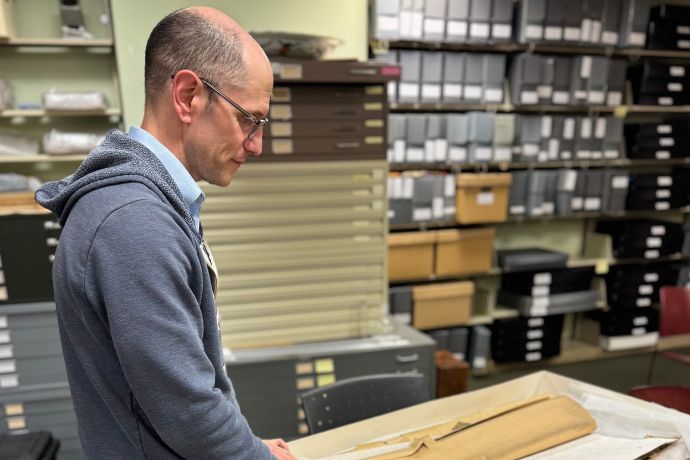
GLENSIDE, Pa (Oct. 2, 2026) – Tucked away in the basement of Landman Library, the archives sit, waiting for students to peel through its fascinating collection of history. Overseeing and managing it: Peter Steinberg. There is seldom a dull moment in the archives, in fact, today, Steinberg works on restoring the original blueprints of the iconic Grey Towers Castle. The paper is brittle and easily cracked, so it is the job of the archivist to bring it back to life. By steaming the paper in a box with hot towels, it is Steinberg’s hope that the paper will become pliable again and be ready to straighten out and dry.
Peter Steinberg graduated from the University of Mary Washington in 1996 with a BA in English Language and Literature. In college is when his interest in archives, and Sylvia Plath, began. In his junior year, he went through a breakup with his first love. His next move? “I did what you do, which is take a poetry class,” said Steinberg. The class had nothing to do with Plath specifically, rather, it was a general class that featured her when they covered the 1950s and 1960s.
Steinberg’s first encounter with Plath was her poem “Lady Lazarus,” a feminization of the Biblical tale. This poem was deeply relatable to him at the time and what he took from it was that, “this mess of a wreck that I was at the time, [was] temporary, that I [would] get over it and rise out of my own sort of ashes…”
However, Steinberg’s experience in class was unique. Instead of his interest being encouraged, his professor discouraged him from pursuing this interest. This upset Steinberg, but did not dissuade him from Plath—despite the sordid attempts of his professor. Steinberg and a friend who was familiar with Plath went to the library and checked out a ton of her work. This was only the beginning of a long career of collection and archiving.
Plath gave Steinberg the opportunity to meet and connect with people that he says he would not have met under different circumstances, especially when the internet became a popular tool. It was a man named Jack that recommended he go to Smith College and check out their Sylvia Plath archives. “I had never been in an archive, didn’t really know what they were. So I took a week off of work and went up there, and spent a week in the archive, and just fell absolutely in love with archives and research and fell deeper into studying Plath too.”
Ironically, through all of his time studying her, Steinberg does not think that Plath would like him. “I’m too short,” he said. “[In the Bell Jar she wrote] she always would stand with one hip kind of cocked a little bit lower to make it not seem that she was so tall. And she was 5 ’10 “. I used to be 5 ‘8 “.” Also during this conversation, Steinberg mentioned that he is a vegetarian, so, if he were to have dinner with Plath, his first question to her would be: “Is this vegetarian?”
Steinberg’s fascination with Plath is what sparked his interest in archival pursuits. And so, his collecting started with the Bell Jar. “I think I just started collecting editions of the Bell Jar. I got a copy for Christmas in 1994. And then in the winter of ’95, I went over to Europe for the first time. And in London, I bought a copy of the Bell Jar there because it was a different cover.”
In his time collecting, Steinberg came upon quite a few rarer items. His most proud item of his collection is a letter of Plath’s. “Because I edited her letters, her daughter ended up selling some letters that she had to either Ted Hughes or Ted Hughes’ parents maybe seven years ago. And I was able to buy one of those and I wanted it because I had edited it and I just thought it would be really nice to have something like that.”
However, all good things must eventually come to an end and Steinberg has sold a good portion of what he had collected all those years. “I had told myself, maybe around 2015, I said, when I turn 50, or when [The Collected Prose of Sylvia Plath] comes out, that’s it. And it ended up that both those things happened within two months of each other.” A good portion of Steinberg’s collection went to Utica University. A man there has Plath written into the permanent curriculum, and he wanted a place that could permanently make use of his findings.
As of Mar. 2025, Steinberg is an archivist right here at Arcadia University. When asked about how he ended up here, he said, “I applied for the position because I felt that the job at Arcadia would be a great challenge and experience, as well as a growth opportunity in my career.” The archives is a place that every student should stop by at some point because there is something for everyone there with how much variety there is even if the space is relatively small.
Another feature of Steinberg’s work is how different it can be from day to day. From hosting classes, to restoring blueprints, every day is something new. “It’s getting to work with people across the campus, whether it’s in the theater department, art department, English department, history, what have you…But it’s really just, almost kind of deciding what I want to work with on any given day.”
As anyone that is passionate about their work, a big motivation for Steinberg is sharing his work and findings with others. “I hope it lets them touch history,” he said when asked about what he hopes students will take away from their time in the archives. The archives are an integral part of the school’s history. We cannot see who we are now if we don’t know who we were. People like Peter Steinberg do the work for us, all we have to do is reach out.
Photo credited to Arianna Eyer.