By Vincent Rodriguez and Liz Ravenel
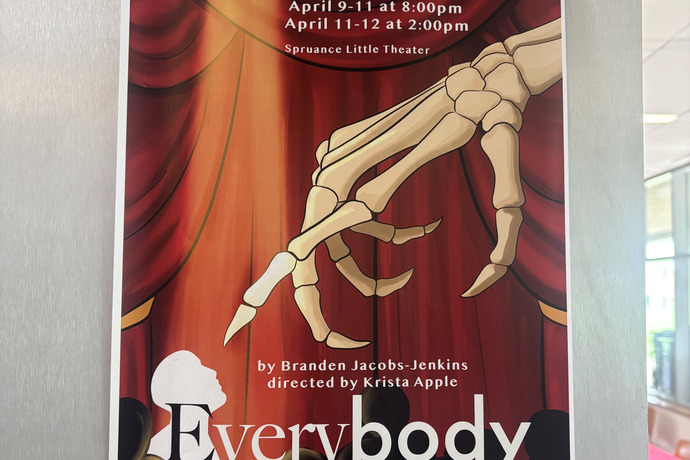
GLENSIDE, Pa (Apr. 9-12, 2026) – The Arcadia University theater department put on their latest show. Everybody, written by Branden Jacob-Jenkins and directed by Krista Apple, is an adaptation of an old 15th-century morality play called Everyman. Now, the original play of Everyman was about representing how you should live your life while representing true catholic values. However, Everybody seems to take that idea and turn it on its head.
The main story starts off with God (yes, that God), played by Kaylee Kramer, as they command Death itself, played by Sarah Meissler, to bring Everybody to the other side and make them give a presentation of their life. The story and concept of Everybody is quite unique. First off, one of the main attractions to this play is the fact that its main actors are chosen at random. This act is done to relate to important topics and themes that reside in the play, such as the randomness and uncertainty of death. The way that our theater department interpreted this idea was through the lens of three different actors playing the main character of Everybody. These actors included Prophett, Eric Lavelle, and Dillon Diorio, who were also chosen at random from a game of Plinko that was also done by a random audience member every show.
Along with the unique lottery system, another thing that makes Everybody a standout show is that all of the actors do not play regular characters as you know them, but rather concepts. The main character of Everybody doesn’t just use the name for style, but rather to literally represent, well, everybody. The use of these concepts is what makes the play so interesting; the audience is literally watching how everybody reacts to different ideas. Interactions with concepts such as Friendship, played by Jaymie Lewis, and Stuff, played by Evan Wagg, give heavy insight into the minds of ourselves, which is exactly what the play is trying to do. Each concept has such a different relationship to Everybody, and their interactions reflect real-world ideas.
For instance, Everybody’s interaction with Cousin and Kinship is filled with these concepts, treating Everybody with open arms and kindness. However, once Everybody asks them to go with him on their journey to death, they reject the ask even though they claim to always be by his side. While on the other hand, Everybody’s interaction with Love, played by Brazil Taylor, is one filled with struggle and hardship, with Love starting off angry at everybody because of feelings of rejection, and Everybody having to surrender themself to accept love and to actually be able to take Love with them into death.
Now, the same level of uniqueness that was seen in the characters of the show was also shown throughout the production of the entire show. Different actors were planted in the crowd to make it seem like the audience itself was being addressed by these concepts. Throughout the play, the assistant stage managers Addy Potter and Miles Riggs were used as another way to basically break the 4th wall. While they were the assistant stage managers, they were also a part of the show in the way that they would be moving around props and interacting with some of the performers. It is details like this that allowed the audience to feel immersed in this story, like they were witnessing these events play out in real time. Audience members referencing the fact that we are in a theater, actors staring directly into the audience, and literal references to Arcadia itself are all used to create this trippy, but also engaging, performance for the crowd. The most prevalent example of this is definitely towards the end of the show; after a scene, the curtains get “accidentally” torn down to reveal the backstage area of the theater. In this, we get a brilliant moment of calmness as the entirety of the cast comes together in a familial-like state, and they do a beautiful performance of “Rivers and Roads” by The Head and the Heart. No interesting dialogue between characters, no narrative; they just sing.
This performance truly shows the meaning of a production. Everywhere you look during this show, you can find something special. Every aspect provides meaning; from the dialogue, to the design, to the set, to the little moments like the singing ensemble— everything has meaning. These driven ideas feed the play’s narrative of finding reason and meaning in one’s own life. To be able to look back into your own mind and see what values you may prioritize and live by. It’s as foreign as it is familiar and as human as it is divine. From parents to children, from students to teachers, this play is for everybody.
Photo credited to Bird Parry.