By Bird Parry and Liz Ravenel
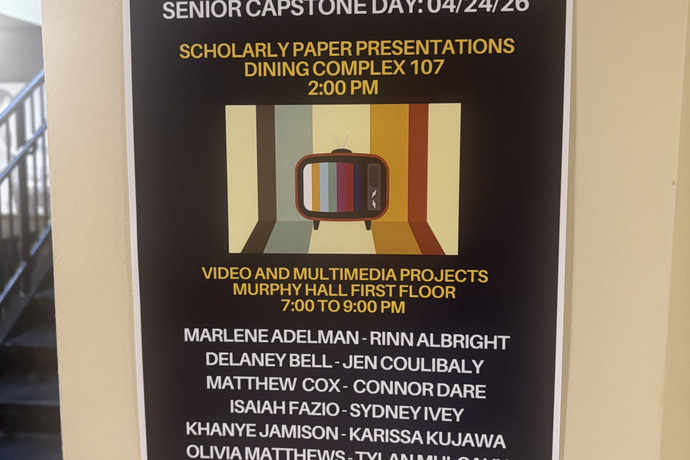
GLENSIDE, Pa (Apr. 23-May. 6, 2026) – Senior Capstone will come to an end on May. 6, and is the final academic step in the journey of the class of 2026. It’s a momentous occasion; classes are cancelled so that non-seniors can support the seniors and their hard work on display in these presentations. These are some of the most interesting projects, and insight into their capstone experiences.
Public Health and Psychology
GLENSIDE, PA (Apr. 24, 2026) – Gathered in Alumni Gymnasium, around 40 students showcased their projects on posters. Kailyn Houston-Young, a psychology major, researched academic success for students of color at predominantly white institutions. “In the psych department, your professor really does not walk you through it,” said Houston-Young. “I definitely had a lot of fun researching my topic because I’m very passionate about it.”
Corey Attivo, a psychology major, who researched the effect social media has on adolescent mental health. “I tried to enjoy the process as much as I could, because it’s a real blessing to be able to do a senior capstone,” said Attivo. He also spoke on the difficulty of actually writing a thesis paper. “The writing process was the most difficult, because it’s hard to write 25 pages and just keep trying to find stuff to write.’
Augustus Kuebler, a psychology major with a gender and sexuality minor, researched the impact parental narcissism has on childhood attachment. “It’s definitely a mix of emotions, very overwhelming, very confusing at times,” said Kuebler. “But as I was wrapping it up, it’s definitely [been] very exciting and almost like closure in a way.”
English
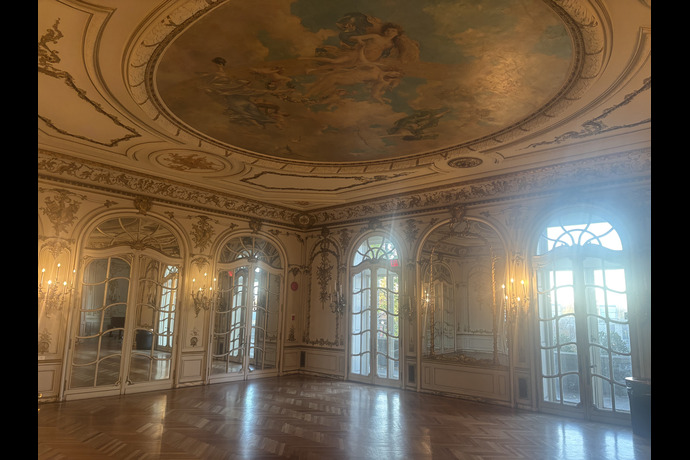
GLENSIDE, PA (Apr. 24, 2026) – Gathered in the Great Room, nine students gave presentations showcasing their work over their Senior Capstone. Brielle Ludwig, an English major with a concentration in literature, analyzed the loneliness epidemic in comparison to the book and film Fight Club. “It was most certainly stressful,” said Ludwig about the Capstone process. “But I found that because I based my research around something that I was extremely interested in, it made it a million times easier.”
Emma Ambrose, an English major with a concentration in literature, researched the intersectionality of anti-black racism, misogyny, and homophobia that black lesbians face. They did this through examining the 1979 Loving Her by Ann Allen Shockley. “You examine an issue very, very extensively. You find a book and execute your reading through your lens of the issue that you’d focused on,” said Ambrose on their process in Capstone. “I think that it is a really rewarding experience, but there definitely were a lot of time constraints that contributed to our stress.”
Theater Arts
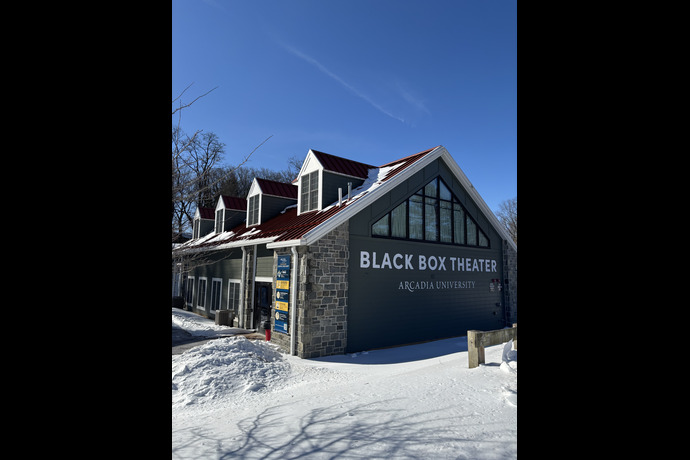
GLENSIDE, PA (Apr. 24, 2026) – Held in the Little Theater, about nine theater arts seniors demonstrated their presentations utilizing tri-fold poster boards and pictures from their theses taken throughout the week. These theses, which ranged from staged readings of scripts to full-on productions with costumes, sets, hair, and makeup, were performed from April 18th through April 23rd.
William Morris wrote his own play called 70/30. This was based on the ratio of women versus men in the theatre program at Arcadia.
Michelle Teske, a BFA Acting major with a minor in music, wrote her own show as well. How To Grieve: Family Edition was inspired by her own family. She did lots of brainstorming and thought about what she had done before college and what kinds of stories she wanted to tell in her thesis. Teske pulled six different pieces from five different areas of media, such as Superboy and the Invisible Girl from Next to Normal by Brian Yorkey, a scene out of Rabbit Hole by David Lindsay-Abaire, a scene from Proof by David Auburn, the song Unlikely Lovers from Falsettos by William Finn, as well as a monologue from Romeo and Juliet by William Shakespeare. She finished off the show with a family favorite that reminded her of her grandmother: the song Over the Rainbow by Israel Kamakawiwoʻole.
I had the opportunity to witness two theses in person. Becca Remelgado starred in an abridged version of Love in Hate Nation, a musical written by Joe Iconis who created Be More Chill. The show is about a women’s reformatory in the 1960s. This reformatory, also referred to as “Nation,” housed girls who were sent away for not fitting the status quo. The musical, which is usually played as a 90-minute show, was turned into a one-act 60-minute performance. The show explored topics of suicide, queerness, and feminism.
The second thesis I watched was a collaborative performance by Zara Peters and Veronica Nardo. The piece, Muscle Memories, was written by Peters, choreographed by Nardo, and directed by both. The show told the story of Ovis and Agnus; these two characters are one, as Ovis is the current form of Agnus. Throughout the show, Ovis is reliving traumatic experiences as well as watching Agnus live through these for the first time. Utilizing poetry, music, Greek mythology, the color red, choreography, and American Sign Language, this original show delved into serious topics, like violence, self-harm, and depression.
Biology
In the Kuch gym, the biology majors had posters filling the entire room with two different types of research—library and lab. One of the library research projects was done by Molly Nemeth on treating Rett syndrome, a rare genetic neurological and developmental disorder. According to the International Rett Syndrome Foundation, “caused by a spontaneous pathogenic variant—or mutation—in a gene called MECP2 that is located on the X chromosome.” Those who suffer from Rett Syndrome impact one’s ability to complete basic human functions, like walking, speaking, eating, and breathing. One of the lab research projects by Abby Stephens was done on genes of drosophila or, if you aren’t a biology major, fruit flies. Her project researched the role of DNA2 in drosophila melanogaster nuclear and mitochondrial DNA replication.
It was a pleasure to witness these presentations and see the hard work the seniors put into their projects. The joy that each student expressed in having completed their projects, and the relief from the stress they felt was truly magnificent. It’s important to attend these capstone presentations not only because they’re interesting to watch, but to support the hard work the seniors put into their projects. After all, it won’t be long until you’ll be a senior giving your capstone presentation!
Photo credited to Bird Parry.